Friday, April 17, 2009

The Evil in Pemberley House by Philip José Farmer and Win Scott Eckert


The great Grandmaster of science fiction, Philip José Farmer, was the consummate bibliophile. He was well read in classical English prose as well as the more popular literary works of modern times. His love for the broad sweep of English literature led him to create the Wold Newton Family, named after a place in England where a meteor had come to ground on 13 December 1795. Phil united all of his favorite literary characters and genres in one enormous scheme that spanned the entire length of human history even into the future.


Mr. Farmer first proposed his grand vision in his biography of the man whose life was fictionalized by Edgar Rice Burroughs in the Tarzan series. This book Tarzan, Alive! (1972) launched the Wold Newton Family. Farmer traced the family history of Tarzan, Lord Greystoke, through several centuries of English literary and historical characters. He continued this project in his next biographical work Doc Savage: An Apocalyptic Life (1973). Farmer had previously postulated a family link between Tarzan and Doc Savage in his controversial novel A Feast Unknown (1969). In his later biographical works, he documented the research to make the case for that relationship. Thus he was able to link Elizabeth Bennett from Pride and Prejudice to Sherlock Holmes, Major Barbara, Fu Manchu, The Time Traveler, and Robert Harrison Blake from the Cthulhu mythos.


Phil Farmer was always a maverick and an innovator. It is no surprise that he decided in the mid 1970s to write his own version of the romantic English novel but with a modern erotic twist. In this he anticipated by over a decade the trend in Harlequin-style romance novels which have become even more graphic than he had imagined 30 years ago. The story would wed together the settings and characters from his favorite works of literature and the extended Wold Newton Family he had created to unite them. Thus was born the original outline for the novel The Evil in Pemberley House.


As often happens to men of literary genius, Phil Farmer's fertile imagination birthed many plot lines, some of which would never be brought to fruition. There are so many ideas yet there is so little time. As he completed work on his Riverworld series, started his Dayworld series, and finished the one work of which he was most proud (The Unreasoning Mask), The Evil in Pemberley House receded into the background and became an idea he had discussed with a few friends and colleagues decades earlier. But the written outline remained hidden in his file cabinet along with other tantalizing projects that never were developed. It was very much like that battered dispatch box of Dr. John Watson hidden in a bank vault on Charing Cross Road containing notes on the unwritten cases of Sherlock Holmes.


Eventually, the outline of Pemberley House came to the attention of Win Scott Eckert who has published widely on the web and in print on the Wold Newton Universe. He has helped to make the Wold Newton Universe an on-going world-wide phenomenon. Win realized the importance of this novel to the Wold Newton legacy especially since it came from Philip José Farmer himself who had conceived of Pemberley House at the height of his creative effort in creating the Wold Newton Universe. With permission from Phil and his wife Bette, Win collaborated with Phil in fleshing out the story and preparing it for publication. The final editing was completed in 2008 and Phil Farmer lived long enough to learn that his Pemberley House story was to be published by Subterranean Press in 2009. The master story teller Phil Farmer passed away on 25 February 2009 at the age of 91, but his legacy lives on.


The story of The Evil in Pemberley House is set in 1973. The heroine, Patricia Wildman, is the daughter of the great adventurer, Dr. James Clark "Doc" Wildman who had recently died along with her mother in a plane crash somewhere in the arctic. Their bodies were never found. After her parents' death, Patricia had married one of the physicians who had worked in the clinic with her father, but he dies tragically shortly after they are married and she is left alone and with no close family ties.


Patricia is a tall voluptuous woman with the same golden-flecked eyes, bronzed skin, and red-bronze hair as her father. She had been educated like her father from childhood to be a physical and mental marvel, though not with the same intensity with which her father had been trained. Even though she is a virtual superwoman, Pat is still a lonely young lady who is haunted by the loss of her father. He had been more than a mere parent to her. He was such a paragon of human perfection that he seemed more like a god. His memory still intrudes on her when she is with other men. None of these other men -- even her late husband -- could match up to her father in anything, and she burns with incestuous desire for him even though she knows he is dead.


As she struggles with her loneliness and confusion, she learns that through her father's lineage, she is next in line to inherit Pemberley House, the sprawling mansion in Derbyshire which is featured in Jane Austen's novel Pride and Prejudice. It is also possible that she could receive the title of Baroness of Lambton. Pat decides to go to England and to see Pemberley House for herself and meet the 103 year old Duchess of Pemberley who currently owns the mansion. Based on what she will find, Pat will decide whether or not to accept the inheritance. She hopes that this adventure will take her mind off her recent personal tragedies.


But things are never that simple in a Phil Farmer story!


Pat meets an odd cast of characters: some grotesque, some nasty, some hostile, and virtually all of them lascivious. On the trip from the airport to the mansion, Pat must prove her mettle when she is brutally assaulted. But she shows that she is indeed her Father's daughter and routs her attackers. Pat also discovers that Pemberley House comes with its own ghost and family curse. Early on, Pat finds that many of the occupants of the mansion don't want her there and seemingly will do anything to discourage her from becoming the heir.


The book is filled with conflicts of various kinds including some incidents that would definitely have made the prim Ms. Austen blush. This is after all a Phil Farmer story set in the sexually turbulent 1970s and the erotic content is an integral part of the story. But the sexual content is very tame compared to similar modern stories and is not merely gratuitous.


The colorful cast of characters includes the dowager Duchess and her very personal physician multiple servants with mysterious pasts and those hangers on who gravitate into the lives of wealthy people when there are no relatives to prevent it. There are also the usual bedroom-farce antics and cases of mistaken identity that abound in romantic novels.


Pat is faced with several mysteries that need to be solved. The motives and identities of several characters need to be discovered. She has to understand why odd events in the house keep occurring. And most importantly, she actually confronts the apparent ghostly apparition and needs to determine whether it is truly supernatural or just another scheme to scare her away from the house and her inheritance.


During the main body of the story we are introduced to the history of Pat's family which included her grandfather who was the illegitimate love child of the Duchess's husband and who committed a great crime which sent him into exile to America. There was also a lost scion of the family -- actually the duchess's nephew -- who had been marooned in Africa as a child and who eventually returned to assume the identity of the Duchess's own son. There are also a host of other flamboyant characters that will be quite familiar to fans of Phil Farmer's biographical works. Wold Newton fans will be treated to numerous clarifications and extensions of the Wold Newton Family. Included in the final production form of the novel will be an updated Wold Newton family tree so that fans may keep track.


The denouement of the story is an extended action sequence in which Pat Wildman confronts the real villains and triumphs over them. She is depicted as fighting virtually nude in clothing that has been shredded during the action. It very much reminded me of the iconic image of Doc Savage and his torn shirt made famous by the art work of James Bama from the Bantam reprints of the Super Sagas. This is where the solutions to all the mysteries are revealed. I must comment that the flow of the battle sequences went very smoothly which clearly was the work of Mr. Eckert. Similar sequences by Phil Farmer in other works were often choppy and chaotic. Nevertheless, the content of these sequences was pure Farmer with editorial polish.


Overall, this was a fun book to read. It had action, adventure, mystery, sex, violence, and a large dose of Wold Newton connections. I think the collaboration between Eckert and Farmer was excellent. They made their own contributions to the plot and the final editing gave a satisfying flow to the narrative. The story also left open the possibility of a sequel or two. Or more. If there are any other outlines in Phil Farmer's filing cabinet, I for one would like to see Win Eckert be permitted to flesh them out into full fledged novels.


The Evil in Pemberley House stands on its own as an entertaining story, but in my opinion, one can better appreciate it if one has read the genealogical portions of Tarzan, Alive! and Doc Savage: An Apocalyptic Life. This is not strictly necessary but the reader will be rewarded with a better grasp of the underlying storyline. I think it is also highly recommended that one read Arthur Conan Doyle's Sherlock Holmes story The Adventure of the Priory School which is also quite important to the background of the story


I am so pleased that this classic Philip José Farmer story was rescued from oblivion by the collaboration of Win Eckert and Phil Farmer. Wold Newton fanatics such as myself will find a gold mine of new canonical material from the master himself and bold writers will be able to use this to extend the Farmerian legacy to future generations.


The Evil in Pemberley House by Philip José Farmer and Win Scott Eckert will be published by Subterranean Press on September 30, 2009 in two editions


The trade hardcover edition is current listed here on Amazon.com at a substantial discount.


The Limited Edition of The Evil in Pemberley House is available directly from Subterranean Press. There will be only 200 copies printed each signed by Win Scot Eckert. It will come with an exclusive chapbook of bonus materials that includes Philip Jose Farmer’s original outline for the novel, as well as an extended family tree for the Wold Newton Universe.

Pre-publication orders are currently being accepted at both sites.

Tuesday, April 7, 2009

Philip José Farmer: A Tribute


I want to give a personal tribute to Philip José Farmer the renowned author who passed on to his reward on 25 February 2009. He has been a major influence on my life and thought for 40 years. His work brought me many years of entertainment and thoughtful reflection. From his imagination sprang The Lovers, The Riverworld, the Wold Newton family, The World of Tiers, The Dungeon, The Night of Light, A Feast Unknown, and far too many thoughtful stories for me to catalogue here.


I first came to know Phil through his novel "A Feast Unknown" which was a parody loosely based on the pulp characters Tarzan, Lord Greystroke and Doc Savage. Phil's pastiche characters -- Lord Grandrith and Doc Caliban -- were his take on what a true feral human and Übermensch might be like. These characters were very different from the Pulp heroes upon which they were based. They were heroes for sure, but more human and apt to have flaws and foibles that made them more distant and frightening than their Pulp models.


This was a theme that went through all of Phil's work. He saw the hypocrisy in American society with its racism and prejudices. In his life he had been the victim of scams by powerful men who outwardly praised virtues of fairness and generosity but who stole his ideas and peddled them as their own. Phil was especially sensitive to propaganda that demonized "the other" whether in political, sexual, racial, cultural, or religious terms. He opposed such things openly and wrote some very controversial material which is somewhat tame by modern standards but in its day pushed the envelope of literary propriety.
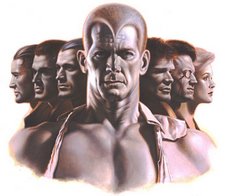


But Phil never lost a sense of what was right and good. In a time when anti-heroes were popular, Phil Farmer wrote about REAL heroes who had values and standards and fought for them. Phil in fact was obsessed with the idea of the hero and in what that actually meant in the real world.


In his literary biographies Tarzan Alive! and Doc Savage: an Apocalyptic Life he took heroic icons from his own childhood and fleshed them out as real people. It was almost a religion to him. Phil once remarked to an interviewer that while some people believed in Jesus, he believed in Doc Savage.


This comment reveals to me that Phil Farmer was on a quest to find meaning in life and something in which to believe. He wrote several stories that were critical of the Fundamentalist Christianity which was so prevalent around him. In reaction against this, there was a time when he flirted with Catholicism. During that time he wrote the Fr. John Carmody stories which are personal favorites of mine. (It is one of my great regrets that Phil died before he could tell the story of what happened at Johns Hopkins to convert the master criminal John Carmody and move him to become a priest.) As a devout Catholic myself, it is obvious that Phil read widely in theology and understood the Catholic faith. In many ways, I can see remnants of that in his later works as well. But Phil could not reconcile the Catholic Church's teachings on sexuality with his own perceptions. I think this in large part inhibited him from converting.


One of my favorite stories by Phil is "St. Francis Kisses his Ass Goodbye." In it, Phil showed an in-depth understanding of St. Francis of Assisi which surprised me. This was projected on to a back drop of the dehumanizing aspects of poverty in the modern world when Il Poverello is projected forward into the 20th Century by a time-machine experiment gone haywire. To save the world from destruction St. Francis must be sent back to his own time. I think this story showed that Phil was not sure the piety of St. Francis really had a place in our day. Yet it was obvious that he appreciated and admired what St. Francis had accomplished in his own time.


Similarly, there was an episode in the Riverworld series where a Catholic Prince established a kingdom along the river which embodied all the virtues of the Catholic faith. Phil described is as a wholesome and good place.


I don't think that Phil ever gave up on God or on the Church. He just could not find a way to believe in perennial values. What Phil could believe in was personal integrity and the heroic spirit. This is what he found in Tarzan and Doc Savage. Good men who made virtuous choices and who persevered against evil even when against the odds.


Phil took this love of the hero to a greater length and created the Wold Newton Family to bring together his favorite heroes from all fiction into one literary universe where goodness and justice would in the end prevail. This was a religious vision of faith and hope in the heroic spirit as something working in history in the hearts and minds of people who projected their values into the stories which entertained and sustained them.


Phil Farmer has moved on now and our prayers and thanks go with him. I hope he finds in eternity what he was searching for in the world's longing for literary heroes. He has left us a great legacy which I will cherish and which I hope to help pass on to posterity. We will likely not see his like again for quite sometime.


Rest in peace, Phil. Thanks for everything. We will miss you. I hope to see you again soon.

Art Sippo MD, MPH

Thursday, January 29, 2009

Monk and Ham's Excellent Adventure


The above is the only known picture of Monk Mayfair (seated) and Ham Brooks (standing to the right). (The identity of the man on the left is not known.) This photograph was taken immediately after they had crossed back to Allied lines after escaping from the Loki Prison Camp and trekking across the Alps.


One of the background stories in the Savage Super Sagas is how Andrew "Monk" Mayfair and Theodore "Ham" Brooks met during World War I. The following rendition of the story was published in the original Doc Savage pulp magazine:


Originally in The Man of Bronze, we were told that General Theodore Marley Brooks was tried by court martial and convicted of stealing the hams, yet in the above retelling, Ham was able to talk his way out of it. So the story had evolved over time even in the Super Sagas.

In Escape from Loki, though, Philip José Farmer informed us that the two incidents happened before the two men were incarcerated in the Loki Prison Camp while Ted Brooks was a Lieutenant Colonel in the French Foreign Legion and Andrew Mayfair was a Lieutenant Colonel in the US Infantry.

Farmer's version of the story seems far more likely. It is doubtful that a general officer would have been convicted of stealing food from the mess and not been stripped of his rank and incarcerated. This would also have jeopardized Ham's ability to practice law back home since such a crime would have had been considered a felony under the Uniform Code of Military Justice. In fact, the penalty for such a crime during wartime could have been execution.

Also, the teaching of rude French words to Monk sounds more like a practical joke among equals, not something a General Officer would do to a subordinate.

So based on the information from the Super Sagas and Escape from Loki, the two practical jokes which defined the relationship between Monk and Ham happened sometime between the Spring of 1917 and their incarceration at Loki in June 1918.

It is reasonable to suppose that Ham had joined the French Foreign Legion years before the United States entered the war. Many men from Harvard had done so. Paris was a very popular place with the American upper crust and several young men from the Ivy League had spent time there before the war. France was also a Republic very much like the United States which did not have a king or formal nobility. Defending her against the Kaiser and the Austro-Hungarian Emperor seemed to be natural for Americans.

Meanwhile, the American forces that came over in April 1917 had no formal chemical warfare training. They depended very heavily on both the British and the French to train and supply them for gas warfare. Gen. Pershing made the decision to send American officers to both Britain and France to observe their respective chemical warfare programs and serve with their units in combat.

With Monk Mayfair's background in chemistry, it is highly likely that he would have been sent as one of these exchange officers. The New Orleans Mayfair line (from which I have argued Monk was descended) was of French extraction, so it would have made sense for him to be sent to serve with a French "Z" unit. There were many Americans in the Foreign Legion and so that might be where he was assigned. That's probably how Monk and Ham met. Ham must have been Monk's sponsor within the Regiment.

This scenario would also explain how Monk and Ham became buddies and started playing practical jokes on each other.

One great mystery is how it was that Ham Brooks made brigadier general between August 1918 when they returned from Loki and the Armistice in November that same year. In fact, we know from Escape from Loki that at the time of their incarceration in the prison camp, Renny was a Captain, and Long Tom was a Lieutenant while Johnny was an civilian (albeit an American spy). Why was it that Monk was the only one of the Furious Five in the military who did not advance in rank after their repatriation?

Someday, someone will have to tell the true story of what really happened to Doc's aides during the Great War.

Wednesday, November 26, 2008

A New On-Line Doc Savage Pastiche


I recently received a comment on my blog by Jean Michel, a writer and artist who has been a Doc Savage fan for many years. He has some of his graphics art-work on display on the "Clash City Design" blogspot.

Jean informed me that he was writing his own Doc Savage pastiche on a blogspot entitled Doc Savage & His Furious Five in The Sinister Plot of Helmut Faust. He asked that I read it and comment on it.

It can be viewed here:

http://docsavagemanofbronze.blogspot.com/

What Jean has done is very interesting. He has re-imagined the characters and created an alternative "Doc Savage" storyline in which familiar names and characters are portrayed in an unfamiliar way. Doc Savage purists may balk at the boldness of his reshaping of the character Lester Dent created, but I have always enjoyed the occasional "Imaginary" or "What if?" stories that were seen on occasion in 1960s comics but have become a mainstay in the comic book world since Alan Moore wrote his ground-breaking "Watchmen" in the 1980s.

Jean is a good writer and he keeps the story moving as he introduces new elements in his own take on the Doc Savage mythos. I await with anticipation his new twist on the old characters and background material. Jean does so many new things that I do not want to give spoilers to his story line.

In any case I am enjoying this exercise in creative writing and I hope that other Doc Savage fans will likewise enjoy them.

One thing I hope to see in the future are some graphic images by Jean depicting the characters and scenes from his story.

Wednesday, October 22, 2008

Doc Savage and Serious Literature

Doc Savage has had a widespread influence in adventure fiction but very few people are aware of his appearances in two pieces of literature.

In 1966 author Truman Capote wrote an intense docudrama book -- what he called a non-fiction novel -- about the 1959 mass murder of the Clutter family in the small Kansas town of Holcomb where people did not even lock their doors at night. It was entitled In Cold Blood: A True Account of a Multiple Murder and Its Consequences. The murders had been done by a couple of drifters and Capote told their story in meticulous detail. His coverage and writing of this story was the basis for the recent critically acclaimed movie Infamous (2006) which boasted an all star cast including Toby Jones, Sigourney Weaver, Daniel Craig, Sandra Bullock, Gwyneth Paltrow, Isabella Rosselini, Jeff Daniels, and Peter Bogdonavich. This was one of the best films I have seen in recent years and I recommend it highly.

In his original book, Truman Capote had a scene in the county courthouse where they are discussing the fate of the two murderers. A local minister brings up how Doc Savage would handle the case not by execution or incarceration, but by operating on the killers brains and curing them.

The Reverend Post, overhearing the conversation, joined in. "Well,"
he said, passing around a snapshot reproduction of Perry Smith's portrait of
Jesus, "any man who could paint this picture can't be one hundred percent
bad. All the same it's hard to know what to do. Capital punishment
is no answer: it doesn't give the sinner time enough to come to God.
Sometimes I despair." A jovial fellow with gold-filled teeth and a silvery
widow's peak, he jovially repeated, "Sometimes I despair. Sometimes I
think old Doc Savage had the right idea. " The Doc Savage to whom he
referred was a fictional hero popular among adolescent readers of pulp magazines
a generation ago. "If you boys remember, Doc Savage was a kind of
superman. He'd made himself proficient in every field -- medicine,
science, philosophy, art. There wasn't much old Doc didn't know or
couldn't do. One of his projects was, he decided to rid the world of
criminals. First he bought a big island out in the ocean. Then he
and his assistants --he had an army of trained assistants -- kidnapped all the
world's criminals and brought them to the island. And Doc Savage operated
on their brains. He removed the part that holds wicked thoughts. And
when they recovered they were all decent citizens. They couldn't commit
crimes because that part of their brain was out.Now it strikes me that surgery
of this nature might really be the answer to --"

A bell, the signal that the jury was returning, interrupted
him...


This reference is probably the cultural high point for Lester Dent's creation and it shows that even a pulp magazine icon may have important ramifications above and beyond the world of mere entertainment.

Tom Tryon was a handsome leading man in the 1950s and 1960s who was born in 1926 and died in 1991. He appeared in such films as The Millionaire, I Married a Monster from Outer Space, Moon Pilot, The Longest Day, Dr. Kildare , and The Cardinal. He also had a number of TV roles including that of Texas John Slaughter for The Wonderful World of Disney.

Today he is best remembered for his novels, most notably The Other (1971) and Harvest Home (1973). It is in the novel The Other that he has a Doc Savage reference in Chapter 1:


Frowning slightly, Niles carefully removed from a pocket a chameleon on a fine silver chain. He dropped it inside his shirt with the tobacco tin, then scrambled across to an upended crate partially hidden by the baskets. A divider in it held a pile of dog-eared magazines. He dug one out, then returned to the pool of light, holding it up to the flame. On the cover a man was struggling against a pack of vicious wolves, their fangs dripping gore onto the snow as they attacked a dogteam hopelessly entangled in the harness of a sled.

"'Doc Savage and the Winter Kingdom of the Akaluks,'" Niles read aloud. He peered expectantly beyond the candlelight into the dark. "Holland?"

"What?"

"I've got this idea, see? For snow."

"Snow." Holland sniggered; was always sniggering.

"Sure. Like Doc Savage and the Winter Kingdom. Remember the frozen tundra? Well, with snow we could have our own Winter Kingdom down here."

"How?" He sounded mildly curious.

"Easy. With cattails."

"Cattails? You mean bulrushes? " Guffaws.

"Sure — bulrushes. It's a good idea, no kidding. If we went down to the river and got cattails, we could shred 'em up and have snow all summer. A Winter Kingdom — huh?" He watched Holland's face while he gave it thought; somehow he was always the one to make the decisions. Certainly Niles was pleased to be with him, pleased with his company, pleased they were not only brothers but friends as well. Only, truthfully, they weren't — not really. Not that Niles didn't desire it — they just weren't close. Niles found Holland strange, unpliant, distant. Often secretive, brooding. Of a dark nature.

Holland was his own person, a loner, and who was there could do anything
about that?

Watching, Niles saw Holland's solemn wink. The Winter Kingdom was pronounced as having possibilities. He felt elated; clever, Holland had called him. In the flickering candlelight he considered how little their contemplation of each other across the dimly lighted space did to bring them closer together, though he passionately wished it. Holland was wearing his favorite pink shirt and khaki shorts rolled at the thighs. His eyes shone remote and glassy like a cat's in the night. Gray like all the Perrys', sober and deep-set under a shock of sun-whitened hair, they were oddly tilted at the corners beneath dark slanting brows, giving occasional random expressions a curiously Oriental cast; sometimes it seemed he must have come riding with Genghis Khan across the steppes from Tartary.

Niles returned the magazine to the crate and resumed his place.


When this novel was filmed in 1972, it included a scene with a shot of a paperback with the title "Doc Savage and the Winter Kingdom of the Akaluks" and a cover that was as described above. This was, of course, not a real Doc Savage novel but it was an homage in one of the premier psychological thrillers of that period.

Tuesday, October 14, 2008

Farmerphile #14 has a lot for Doc Savage fans!

http://www.pjfarmer.com/farmerphile.htm#iss14

The Farmerphile Magazine Issue #14 has several articles that will be of interest to Doc Savage fans.

First of all well known artist Keith Howell is presenting for the first time a graphic representation of the the Wildman Coat of Arms that Phil Farmer had first described in his biographical work Doc Savage: An Apocalyptic Life. Win Eckert arranged for this and I encourage all Doc Savage fans to thank him for this. I have been waiting 34 years for this. Hopefully the new coat of Arms will be available for t-shirts, posters and coffee mugs.


Then we have a excerpt from the new novel written by Phil Farmer and Win Eckert The Evil in Pemberley House. It is the story of Doc Savage's daughter Patricia as she comes to claim her rightful inheritance in England in 1973. The story has many connections to the Wold Newton Universe and its extended family of adventurers. Currently, the authors are searching for a publisher. It is hoped that this completed story will be published very soon.

There is also an article by Savageologist Rick Lai The Doc Ravage Presidential Campaign. All of you are familiar with Rick Lai's masterful Doc Savage Chronology. This new article should be a real treat.

They are also running an article of mine This Played in Peoria? which is based on a brief speech I made at the Farmercon 90 celebration of Phil Farmer's 90th birthday in July 2008.

You may follow the link below to order your copy:

http://www.pjfarmer.com/farmerphile.htm

Saturday, October 4, 2008

The Greystoke Coat of Arms


Here it is: the Greystoke Coat of Arms rendered in full color as described by Phil Farmer and drawn by Bjo Trimble! Now if I could only find the Savage Coat of Arms!

Art

Member Doc Savage Webring

Powered by WebRing.